Showing posts with label Lois McMaster Bujold. Show all posts

Tuesday, December 29, 2020

My Favorite Books of 2020

This year has been a hard year, for all of us, and for varying reasons. One of my escapes is reading. This year I ended up rereading a favorite series of mine at the beginning of the pandemic, and I picked up some new books after I went through my reread. So, for those of you looking for recommendations, here are the books I enjoyed the most this year.

My favorite bookstore
Running with Sherman, by Christopher McDougall - This is the latest book from the barefoot running guy. In this one, he writes about a donkey he rescued from a bad situation and rehabilitated through love, care, attention, and running. Did you know there are races where people run with their donkeys? You don't need to be a runner to enjoy this book. It's heart warming and will bring a smile to your face.

The Strange Case of the Alchemist's Daughter by Theodora Goss - This is the first in a series about the monstrous daughters of mad scientists coming together to form a club and solve mysteries with their friends, Sherlock Holmes and Dr. Watson. The books are witty and thought provoking, and it's so lovely to see a story about women coming together in friendship. This series was a delightful escape from the pandemic.

Devolution by Max Brooks - I listened to this one on audio. Quite a few wonderful actors lend their voices to the narration, including Nathan Fillion. This one ended up being a little too close to the pandemic for comfort, but the main character's complete and utter transformation had me riveted, as did the growing sense of horror.

The Once and Future Witches by Alix E. Harrow - I listened to this one as well, and right around the time of the election. It was a fitting book for early November in that it dealt with the suffragist movement in addition to magic and witchcraft, friendship and love, and family. I found this book to be so powerful, so tender, and so well written that I despaired of ever writing anything as wonderful.

The Vanishing Half by Brit Bennett - A patient recommended this book to me, and I picked it up the next time I went to the bookstore. It follows African-American twins growing up in 1950's Louisiana. One girl chooses to pass as white, marries a white man, and disappears from her family's life while the other marries a black man and lives in the same small town where she grew up. The book explores race, identity, family, and racial injustice, and although it's set in the 1950's through the 1990's, it is one hundred percent relevant to today's world.

And that series I read at the beginning of the pandemic? Lois McMaster Bujold's Vorkosigan series, beginning with Shards of Honor. I love the larger-than-life characters, the way Bujold has given them all such realistic quirks and flaws and yet made them so lovable, the vast scope and history to this world. I've read the first few books quite a few times, and the newer ones less often. It's been about twenty years since I first read the series (as it existed back then), so I've had ample opportunity to read them time and again. They're my comfort, my security blanket, my happy place.

I would love to hear about the books that helped you get through this year.

Monday, March 28, 2016

Living in Another World

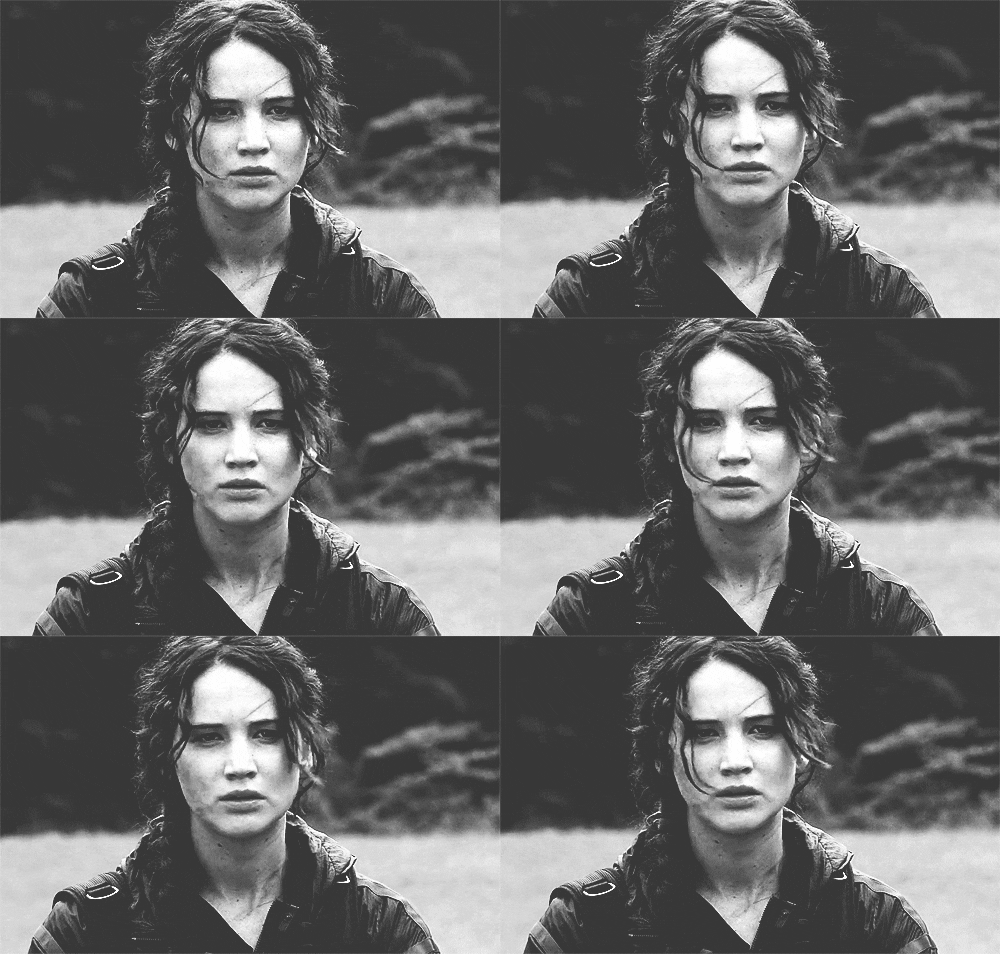
Spend time in District 12? Nope.
I've been thinking about the books I'd want to live in for a while. My first thought was I would definitely never, ever live in The Hunger Games or in Game of Thrones. How funny that I quickly came up with the places I'd stay away from. In contrast, I had to give quite a bit of thought to those places where I'd want to live.

People who know me and my reading habits also know that I'm a huge fan of Lois McMaster Bujold's Vorkosigan series. I love the characters, and I also love the world. It depicts a fascinating future. Years ago I mentioned to a non-sf fan how I would love it if uterine replicators were a real thing, and she thought I was nuts. But imagine a perfect environment for one's developing baby, with the right balance of nutrients, located in a safe place. A woman could go on working in any kind of job, she could drink or eat whatever she wanted, and most importantly, she wouldn't have to go through the stresses on her body that carrying a baby can bring. When I was pregnant with my son, I was diagnosed with pre-eclampsia. It would have been nice to have never experienced that or the uncertainty and fear that goes along with it. My blood pressure was so high before, during, and after delivery that I could feel my heartbeat in my face. My lips throbbed in time with my heart. I nearly wept with joy when I filled my prescription for blood pressure medication and took that first pill. With a uterine replicator, though, my son could have developed in a healthy environment, and I could have stayed healthy myself.

That detail aside, the books also have space travel, other worlds, and fantastic characters. People have better health, and so have longer life spans. One of the main characters, Cordelia, has a life expectancy of somewhere in the neighborhood of 130 years old. How much could a person learn in that lifetime? How many careers could a person have? How much wisdom could a person gain? You could see your grandchildren grow up and have grandchildren of their own.

There's conflict in the Vorkosigan series, and war, but the overall themes are hopeful. There's an underlying current of joy in the stories. While I enjoy novels like The Hunger Games or the Game of Thrones series, they don't make the same impression or give me the same sense of happiness as the Vorkosigan series does. And I certainly wouldn't want to spend any time there.

Monday, April 29, 2013

But What's The Story *Really* About?

I recently read Sidelines by Lois McMaster Bujold, which is a collection of essays, speeches, and travel writing. I found that it's geared more towards writers, but really, anybody who is a huge fan of hers would probably find this a good read.

There are quite a few gems in Sidelines, one of which includes this quote: "A true statement like 'plot is what happens, and theme is what the book's about' failed to create a distinction for me. It wasn't until I became a writer that it came clear. Plot is what a book's about. Theme is what a book's really about."

This was certainly true for me. Back in high school English, we'd read something, and then the teacher would discuss the theme as if it were some hidden message put there by the author, and only the clever people were capable of figuring it out. I felt like there was a code, or maybe a key, that would allow me to figure out the theme (and thus pass the darn test). But theme is both more complicated, and easier, than that.

Many authors don't even know their story's theme, or themes, until after it's written. I might have an inkling of theme when I write, but often I don't have it figured out until afterwards, and then I go through and make sure the story supports it in character action, symbolism, dialogue, etc. Then I hand the story to another person who has a different life experience than me. They bring that with them as they read, and they might find a completely different meaning in the story, and that's okay. Phew. It took me a while to figure that out.

So what is a story really about? It could be about repressive Victorian ideas, or that love conquers all, or a political diatribe, or a comment on how science will make or break humanity, or the role of religion in a person's life, and so forth. There are many meanings that a story can hold. One of the exciting things about having other people read my work is what they bring to it. Sometimes a reader comments upon something in a whole new way, and I see my own story in an entirely new angle, and that's just pretty darn cool.